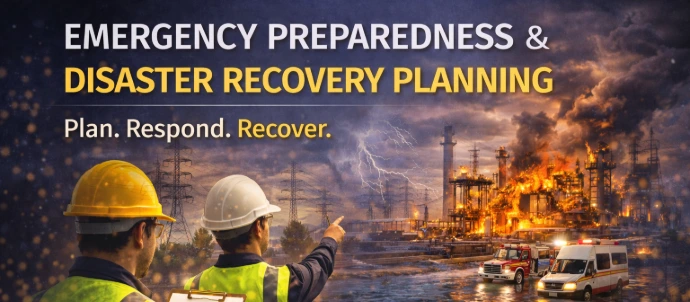
Industries must be prepared for unexpected power events
Prepared systems recover faster and minimize operational losses.
Introduction
Industrial operations depend heavily on continuous electrical power. However, power-related emergencies can occur without warning — and their impact can be severe.
From grid failures to transformer faults, fire incidents, or natural disruptions, unexpected electrical events can halt production, damage infrastructure, and cause significant financial loss.
This is why emergency preparedness and disaster recovery planning are essential components of a strong electrical strategy.
Prepared systems recover faster and minimize operational losses.
Understanding Electrical Emergencies
Industrial electrical disruptions may arise from:
Utility grid failures
Internal transformer breakdowns
Short circuits and fire incidents
Cable faults
Lightning strikes
Flooding or natural disasters
Without preparation, these events can lead to:
Extended production shutdown
Equipment damage
Safety hazards
Missed delivery commitments
Emergency planning transforms uncertainty into controlled response.
Backup Redundancy: Building System Resilience
Backup redundancy ensures that if one power source fails, another immediately supports critical operations.
Redundancy may include:
UPS systems for sensitive loads
Generator integration
Dual power supply arrangements
Automatic Transfer Switch (ATS) systems
Battery backup banks
Redundant design reduces complete system failure risk.
Resilient systems maintain operational confidence.
Emergency Shutdown Procedures
In some situations, safe shutdown is more important than continued operation.
Structured emergency shutdown planning includes:
Clearly defined shutdown hierarchy
Emergency stop mechanisms
Trained personnel response protocol
Protection device coordination
Alarm and notification systems
Proper shutdown procedures prevent escalation of damage and ensure personnel safety.
Controlled shutdown prevents uncontrolled loss.
Critical Load Prioritization
Not all equipment requires backup during emergencies.
Critical load identification ensures:
✔ Essential systems remain operational
✔ Safety equipment continues functioning
✔ Data systems stay protected
✔ Communication remains active
By prioritizing critical loads, industries reduce unnecessary strain on backup systems while protecting vital operations.
Strategic prioritization improves recovery efficiency.
Structured Recovery Planning
After an emergency event, rapid and organized recovery is essential.
A strong recovery plan includes:
Fault diagnosis protocols
Damage assessment procedures
Backup restoration sequence
Load rebalancing verification
Safety inspection before restart
Recovery planning reduces confusion and speeds up operational restoration.
Fast recovery protects revenue and reputation.
Financial & Operational Benefits of Preparedness
EIndustries with disaster recovery planning experience:
Reduced downtime duration
Lower equipment replacement costs
Improved insurance compliance
Enhanced safety standards
Greater stakeholder confidence
Prepared systems reduce panic and improve decision-making under pressure.
Preparedness protects profitability.
Integration with Risk Management Strategy
Emergency preparedness should align with:
Electrical protection systems
Preventive maintenance programs
Safety audits
Smart monitoring systems
Infrastructure scalability planning
Disaster recovery is not a separate plan — it is part of a complete electrical engineering strategy.
Integrated planning strengthens resilience.
The GGS Engineering Perspective
At GGS Engineering Service, emergency preparedness is embedded in our design philosophy.
Our approach includes:
Risk assessment analysis
Backup system integration
Critical load identification
Protection coordination planning
Recovery procedure documentation
Safety compliance verification
We believe strong electrical infrastructure is defined not only by performance during normal operation — but by stability during crisis.
Conclusion
Electrical emergencies are unpredictable — but their impact can be managed through structured preparedness and recovery planning.
Industries that invest in emergency strategies gain resilience, operational stability, and financial protection.
Prepared systems recover faster, protect assets, and maintain business continuity.
Because true reliability is proven during disruption.