Maintenance SOPs
Our 5W1H Maintenance Framework
Structured Through 5W1H. Governed by Engineering Discipline.
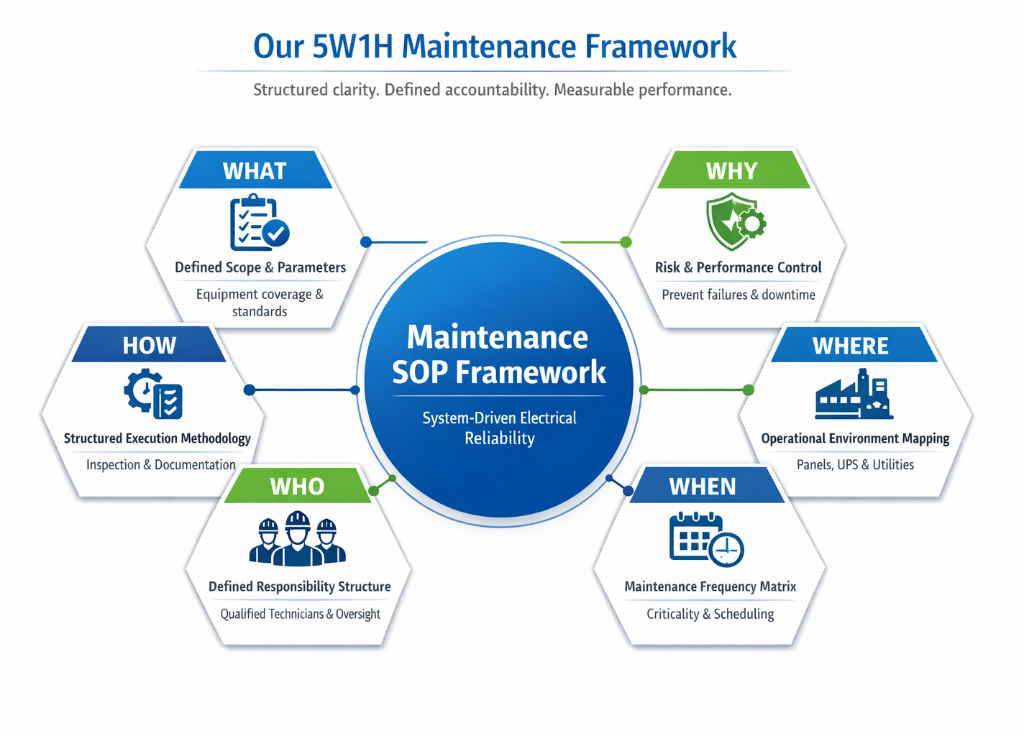
At GGS Engineering Service, Maintenance Standard Operating Procedures are developed using the 5W1H framework—defining what, why, where, when, who, and how of every maintenance activity. This structured methodology ensures that all operational tasks are clearly defined, technically validated, and consistently executed across electrical systems.
The framework is supported by controlled documentation, governance protocols, and performance monitoring mechanisms, ensuring that every procedure remains transparent, traceable, and aligned with engineering best practices.
Through disciplined planning and systematic execution, maintenance activities are transformed from routine interventions into strategic reliability management processes.
5W1H Framework
What – Defined Maintenance Scope
Our SOPs clearly define:
Equipment coverage
Inspection parameters
Testing criteria
Safety controls
Reporting formats
Each procedure eliminates ambiguity and standardizes execution.
Why – Risk & Performance Management
Maintenance SOPs are designed to:
Prevent equipment failure
Minimize downtime exposure
Ensure operational safety
Protect electrical assets
Maintain compliance readiness
Electrical performance stability directly influences business continuity.
Where – Operational Environment Mapping
Procedures are applied across:
Production areas
Utility rooms
Distribution panels
Backup power systems
Underground cable networks
Each environment is assessed for load behavior and risk profile.
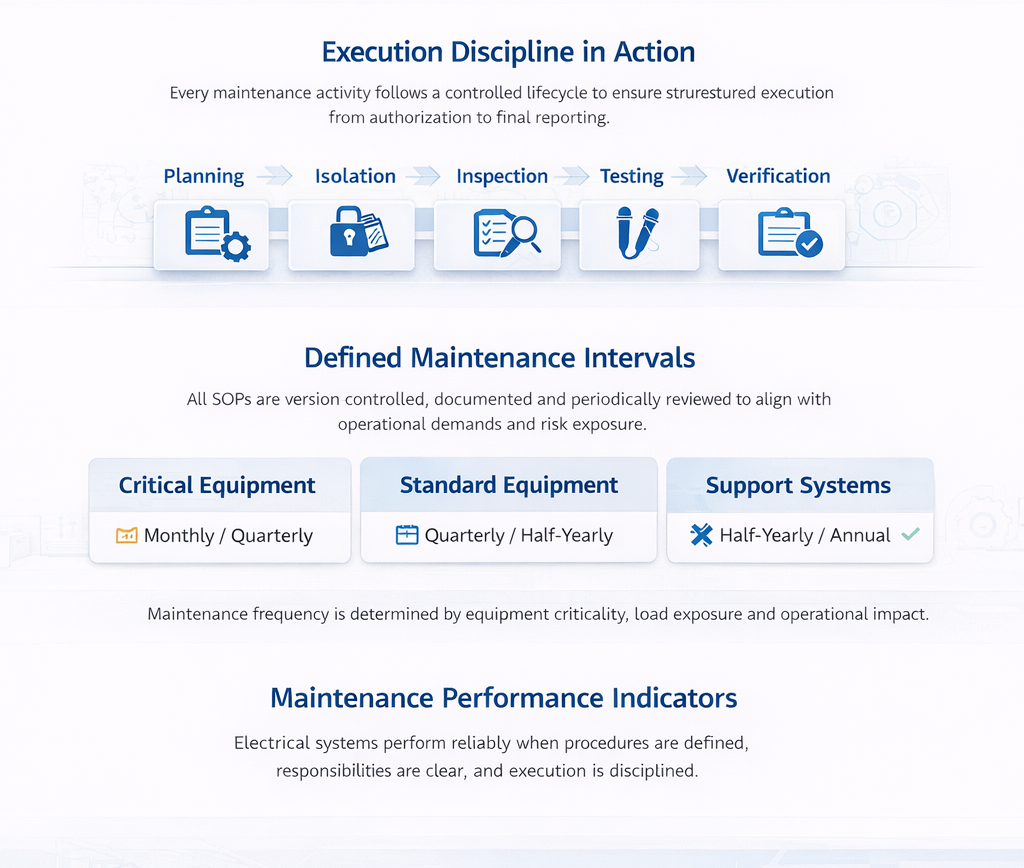
When – Maintenance Frequency Matrix
Maintenance intervals are defined based on:
Equipment criticality index
Load intensity
Environmental exposure
Operating cycle duration
Historical performance records
This creates a preventive maintenance culture rather than reactive repair dependency.
Who – Defined Roles & Accountability
Maintenance execution involves:
Certified Electrical Technicians
Site Supervisory Personnel
Safety Compliance Authority
Technical Oversight & Review
Clear responsibility allocation ensures zero operational gaps.
How – Execution & Control Methodology
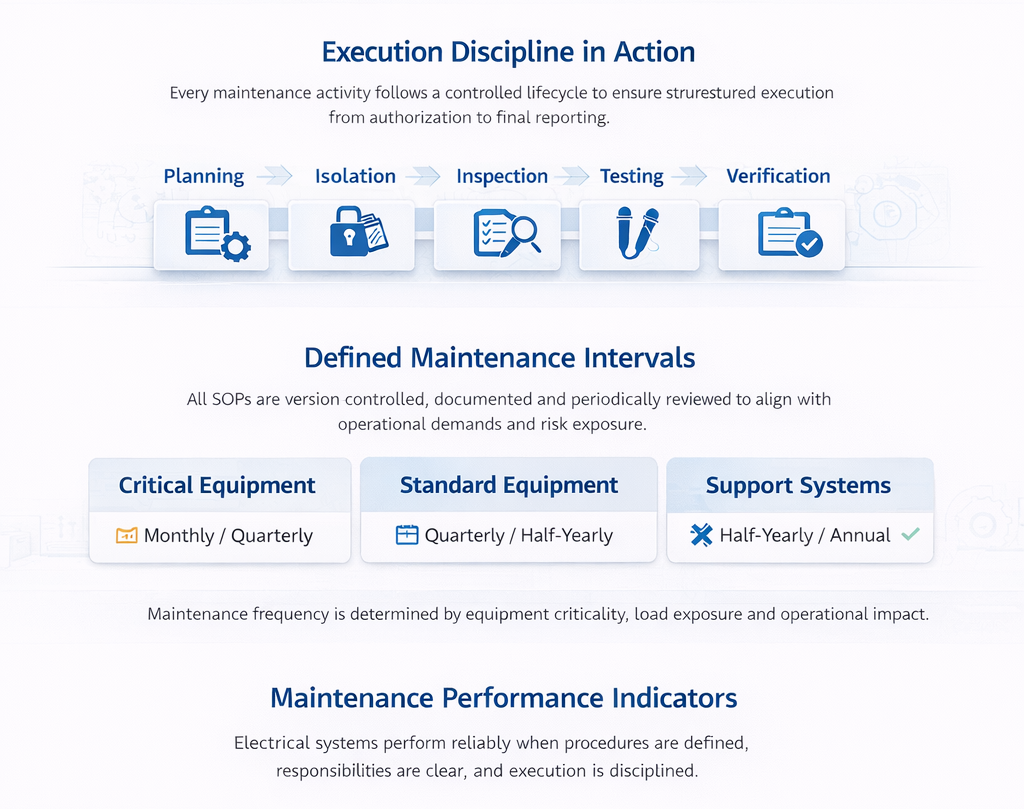
Execution follows structured discipline:
Work Planning & Authorization
Safety Isolation & Lockout–Tagout
Inspection & Testing
Functional Verification
Documentation & Closure
Each stage is recorded for traceability
Governance & Documentation Control

To ensure procedural integrity, our SOP framework includes:
Version control system
Controlled document circulation
Maintenance log registers
Test record archiving
Audit trail documentation
This maintains transparency and accountability across operations.
Performance Monitoring & Review

Maintenance effectiveness is evaluated through:
Downtime analysis
Failure trend tracking
Thermal scan comparisons
Load deviation studies
Periodic technical review meetings
Continuous review strengthens operational reliability.
Continuous Improvement Approach

Our SOP system evolves through:
Field feedback integration
Incident analysis
Engineering updates
Risk reassessment
Process optimization
Maintenance procedures are refined to adapt to changing operational demands.
Structured Maintenance

A disciplined maintenance system ensures:
Operational stability
Energy control
Safety compliance
Extended asset lifespan
Predictable electrical performance
Procedural clarity transforms maintenance from routine activity into performance strategy.
*Defined procedures today ensure uninterrupted performance tomorrow.
Integrated Safety Control
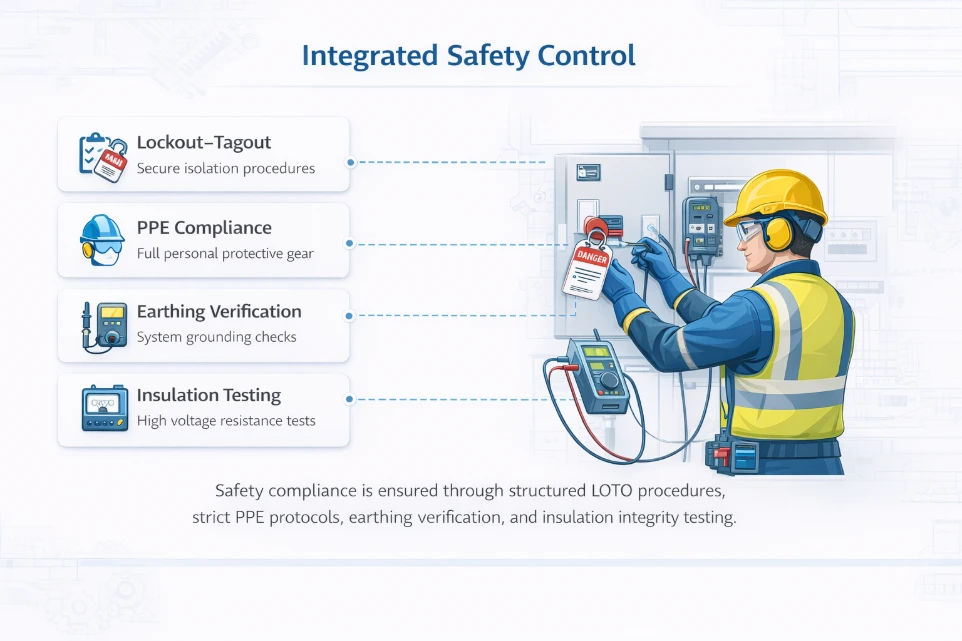
Electrical maintenance activities are performed under a strict safety control framework to protect personnel, equipment, and operational continuity.
Lockout–Tagout (LOTO) ensures safe electrical isolation before maintenance begins.
PPE Compliance requires technicians to use complete protective equipment during all tasks.
Earthing Verification confirms proper grounding to prevent electrical hazards.
Insulation Testing evaluates insulation integrity to maintain system reliability.
*This structured safety approach enables risk-free maintenance operations, regulatory compliance, and long-term electrical system reliability.